When you think about stress, what comes to mind first? Big work and life stressors or the everyday hassles that are part of life? In their new book, The Microstress Effect, Rob Cross and Karen Dillon suggest that microstress—small moments of stress in your personal and professional life that accumulate over time—can have a significant impact on your well-being. They contend that little stressors pile up over time to create bigger impacts on your health and resilience.
According to Cross and Dillon, there are three categories of micro stressors: those that make it hard to keep up, those that drain your energy, and those that make it hard to feel like yourself.
They identified more than a dozen influential micro stressors, such as misaligned roles and priorities, unpredictable authority figures, insufficient communication practices, surges in workload and responsibilities, lack of trust within teams or with leadership, confrontational conversations, and personal values conflicts. One occurrence of a micro stressor might not register as a threat to your well-being, but over time, the effects of micro stress grow.
I noticed that many of the microstressors Cross and Dillion identified overlap with one or more of the six known causes of burnout, which are:
1. Unmanageable workload (you have so much work that you feel like you’re treading water from day to day and that any moment you might sink)
2. Lack of recognition (no positive feedback; you rarely, if ever, hear “thank you”)
3. Lack of leader or colleague support (not feeling a sense of belonging at work; there is little community or team trust at work)
4. Unfairness (favoritism; arbitrary decision-making)
5. Values disconnect (what you find important about work doesn’t match the workplace’s values)
6. Lack of autonomy (having little choice as to how and when you perform the tasks related to your work)
What I loved about Cross and Dillon’s approach is that they focus on your relationships and interpersonal interactions as the critical pathways for helping you better manage microstress. Why? These connections provide important pathways to thriving and resilience, such as levity, perspective, humor, empathy, and support. Specifically, they suggest you need to have the right people in the following seven categories:
1. Providing empathetic support: Who lets you vent and helps you feel like they are there to listen?
2. Identifying a path forward: These people give you good, practical advice and help you see options. They are also good at explaining how they handled a similarly tough situation.
3. Offering perspective: When you overthink, this person gives you some much-needed perspective to help you realize it’s likely not as bad as you might think.
4. Managing the surge: Unpredictable client demands, new projects, company growth, and layoffs are all factors that might lead to a surge in the amount of work responsibilities you have. This inevitably spills over into other areas of your life. Who are the people you can count on when you are overwhelmed with demands?
5. Taking a break: Who helps you take a break or a pause from your stress?
6. Providing levity: These are the people you can count on to provide humor and lightness during a challenge. I remember working with a group of soldiers, and they were talking about a stressful deployment and a particularly dangerous mission. When I asked them how they coped with the stress, they responded in unison, “Ma’am, if it wasn’t for the jokes and the laughter, none of us would have made it.”
Humor can be a powerful coping mechanism for stress. In one study of a group of nurses, their level of humor was found to be a significant predictor of their overall health. In addition, there is a well-developed science of positive emotions showing their connection to increased resilience and reducing the negative effects of stress.
7. Making sense of people and politics: This person may have a broader team or organizational view and can give you a better understanding of others’ behavior.
Now think about your own network. Whose name would you put in each category? Where are your gaps? Do you have the same person listed for each category? That might suggest your network is a bit thin, and you may want to consider ways to increase it more strategically.
I noticed immediately that I really miss having a business coach. My business coach was so good at helping me see a path forward with business and entrepreneurial stressors. I also realized that I am underutilizing both my dad and my brother for work-related perspectives, both of whom have significant business expertise. Having a well-designed network allows you to flexibly reach out to the right people in small but powerful ways for the right kind of support, both personally and professionally.
Small stressors add up over time, though they may not immediately impact your well-being in the same way that big work and life stressors do. Cultivating relationships across these seven categories will help you increase your resilience and ability to thrive when both the small and the big work and life challenges strike.
derived from psychology today
?>17 Nov 2021 by Saima Latif, Ph.D.
Scientifically reviewed by Tiffany Sauber Millacci, Ph.D.
Positive intelligence has become a popular term in the executive coaching world.
It is the new ‘intelligence’ of this decade, just as emotional intelligence was in the last decade and cognitive intelligence was in the decade before that.
Positive intelligence indicates how your mind acts in your best interest, and the good news is that it is a skill you can build.
In this article, you will learn about the positive intelligence quotient, its application to coaching, saboteurs, and how to stay positive as a coach. We also share great exercises and books toward the end of this article and hope you will feel very inspired to use this material in your sessions.
Before you continue, we thought you might like to download our three Emotional Intelligence Exercises for free. These science-based exercises will not only enhance your ability to understand and work with your emotions, but also give you the tools to foster the positive intelligence of your clients, students, or employees.
This Article Contains
- What Is the Positive Intelligence Quotient?
- 10 Types of Internal Saboteurs
- Positive Intelligence Coaching Explained
- Measuring PQ: 3 Assessments & Tests
- 3 Helpful Exercises for Coaches
- 3 Books About Saboteurs & PQ
- PositivePsychology.com’s Resources
- A Take-Home Message
- References
What Is the Positive Intelligence Quotient?
The positive intelligence quotient (PQ) is used as a measure of mental fitness. It is the percentage of time the mind is being positive, allowing it to flourish — a big factor in allowing you to reach your full potential.
PQ measures the strength of an individual’s positive mental muscles (sometimes called their “sage”) versus their negative ( the “saboteur”). The self-command muscle is the ability an individual has to boost their sage and dampen down their saboteur (Chamine, 2012). You will learn more about how to boost this muscle with exercises later on in this article.
Think of physical fitness in terms of enduring physical activity, with little effort or negative impact involved. If you are not physically fit, you will experience physical stress with minimal physical activity.
The analogy can also be applied for mental fitness. If you are not mentally fit, you may experience mental stress. This can come in the form of depression, anxiety, frustration, and anger (Chamine, 2012). It will inevitably impact education, work, family, relationships, social interactions, and recreation.
Chamine (2012) describes saboteurs as being habitual mind patterns, reacting to challenges and generating negative emotions. You flounder rather than flourish. You may experience stress, disappointment, regret, anger, guilt, shame, and worry. The antagonist to the saboteurs is the sage.
This aspect of your mental fitness manages challenges through positive emotions. These may be empathy, gratitude, creativity, curiosity, self-confidence, clarity, and action.
Is positive intelligence science-based?
Shirzad Chamine (2012) is best known for his development of the theory of positive intelligence. He argues that positive intelligence is based on research from performance science, neuroscience, and cognitive and positive psychology. He describes the research as independently validating positive intelligence.
Chamine and Katayama (2012) state that there are different parts of the brain that control the saboteurs and the sage. The survival part of the brain controls physical and emotional functioning and influences the saboteurs, while the sage is controlled by the PQ brain and consists of the middle prefrontal cortex, the right brain, and the empathy circuit. The PQ brain releases endorphins that counteract the stress-related saboteur hormones.
In an analysis of over 200 different scientific studies, the overall conclusion was that higher levels of PQ lead to greater success in work, marriage, health, friendships, and social and creative domains (Chamine, 2012).
Chamine examined research by Gottman and Silver (2015), who have produced many positive observations around marriage. Also, Fredrickson and Losada (2005) found that university students who made more positive than negative statements had improved mental health.10 Types of Internal Saboteurs
Chamine (2012) states that both saboteurs and sages reside in different parts of the brain.
The good news is that saboteurs are not static or fixed for life. They can be changed and weakened, boosting the sage. Exercises described later on in this article can make this happen.
Not everyone is affected by all 10 of the saboteurs at the same time and in the same way. Different people are affected by different types of saboteurs. The judge is the universal master for all people and a common saboteur that afflicts all individuals.
There are 10 internal saboteurs:
1. Judge
Often described as the universal saboteur, the judge will beat you up over repeated mistakes. It obsessively warns you about future risks. It causes you to worry and become easily obsessed and fixated on negativity. The judge is an enemy. It can go on to trigger other saboteurs and cause unnecessary stress, ultimately reducing your overall effectiveness.
2. Victim
The victim does not feel accepted. It tries to attract affection through attention. It focuses on painful, internal feelings and when criticized, it tends to withdraw. The victim receives attention through its emotional problems, poor temperament, or sullen behavior. The victim feels alone, isolated, sad, and abandoned. It feels frustrated, helpless, and guilty.
3. Pleaser
The pleaser tries to gain acceptance and affection by helping others. This meets its emotional needs. It pleases, flatters, and rescues. The pleaser loses sight of its own needs and can become resentful.
It has a strong need to be liked by others, which it does so indirectly so that others feel obliged to reciprocate care. The pleaser is bothered when others do not care what it has done.
4. Restless
The restless saboteur looks for excitement from many activities. It is easily distracted and bounces back from unpleasant feelings and seeks new stimulation.
Attention is constantly shifted and impatience is constant. It avoids a real and lasting focus on any issues or relationships. Restless saboteurs provide a substitute for self-nurture and an escape from anxiety and pain.
5. Hyper-vigilant
The hyper-vigilant saboteur shows continuous fear and anxiety about danger. It worries about things that may go wrong. It is self-doubting about itself and others all the time.
The hyper-vigilant saboteur is always suspicious of what others may be up to. It seeks reassurance and guidance through rules, procedures, and authorities. The hyper-vigilant saboteur often feels skeptical and cynical. It perceives that life is full of danger.
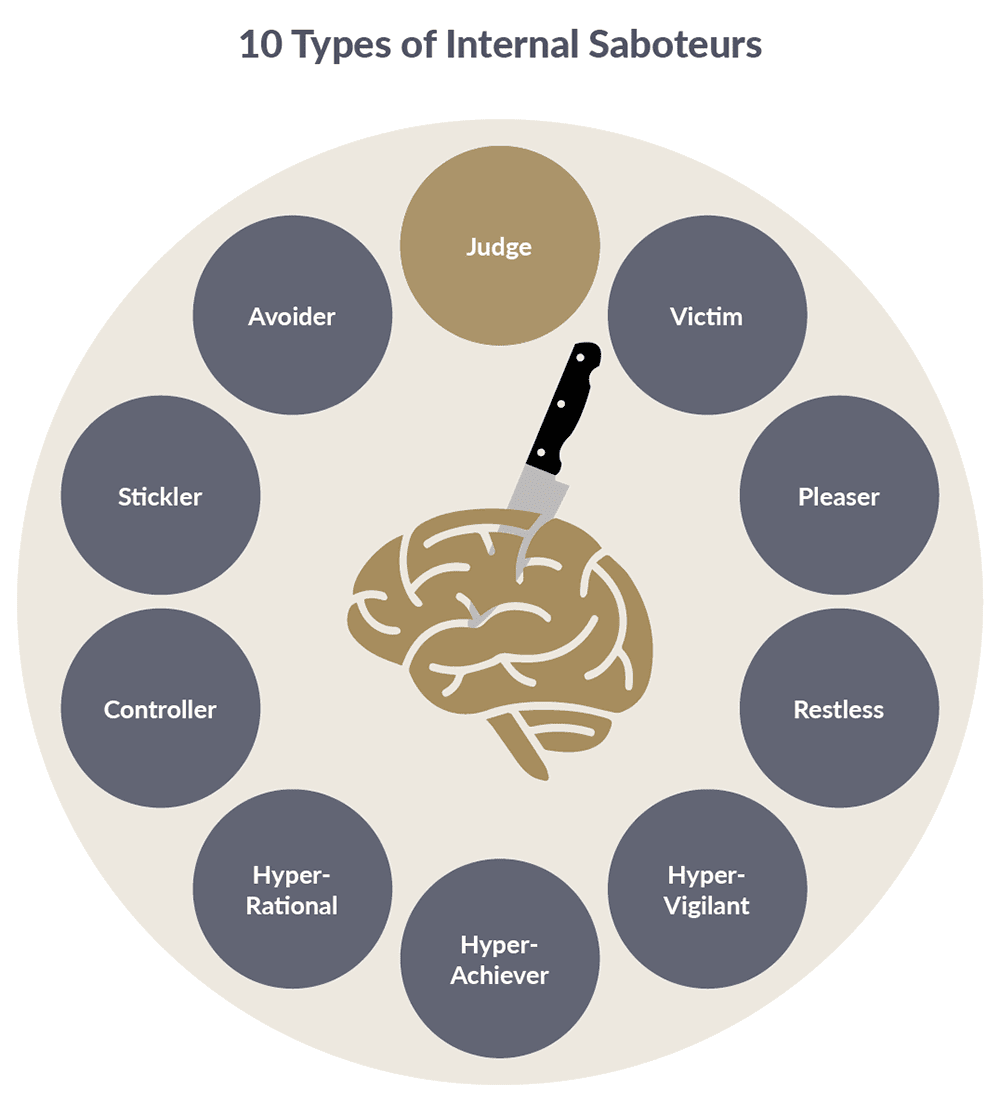
6. Hyper-achiever
The hyper-achiever seeks self-respect and validation from constant performance. This can lead to a goal-oriented and workaholic streak and losing touch with relationships and emotional needs. It adapts its personality to impress other people. It wants to perfect the outer rather than the inner self.
The overall need is to feel successful, as this creates a feeling of worthiness. Happiness is achieved through achievements. It is unable to connect on a deeper level with others.
7. Hyper-rational
This saboteur focuses on processing everything rationally. High concentration can cause a loss of focus. Insight, knowledge, and understanding is valued most. It analyzes rather than experiences feelings.
The hyper-rational saboteur has a good survival strategy. It escapes into an orderly, rational mind, generating security and intellectual superiority. Attention and praise are gained from being the most clever person.
8. Controller
This saboteur has an anxiety-based urge to take charge. It wants to be in control of situations and people’s actions. It is a strong talker, willful and confrontational. The controller pushes others beyond their comfort zone. The controller can be stimulating and intimidating.
Communication can be expressed in an angry and critical way. When it feels hurt or rejected, it will not admit to this. The controller gets results, but these are temporary and at the cost of others feeling controlled and resentful.
9. Stickler
The stickler is a perfectionist and has a need to keep things in order and organized. It can be highly critical of itself and others. The stickler strongly requires self-control. It has high standards and needs to be methodical.
There is constant frustration with itself and others. The stickler is sarcastic and self-righteous. There is inflexibility to deal with change and the different styles of others. Other people are left feeling resentful, anxious, and full of self-doubt.
10. Avoider
The avoider focuses on the pleasant and positive and avoids the difficult and unpleasant. It has difficulty saying no, resists others, prefers comfort and routine, and procrastinates when tasks are not pleasant.
The avoider will suppress anger and resentment, rather than express these emotions. It denies conflict and negative relationships, and trust from others can be superficial as there is conflict-avoidance and others’ trust levels are reduced.
?>MAR. 9, 2022
Don’t be angry, it can be self-destructive Extract and summary from psychologytoday.com, for more reading see link click here This has been extracted from psychologytoday.com, for more see the link Do you fume when someone cuts you off in traffic? Does your blood pressure rocket when your child refuses to cooperate? If so, you are not alone. Everyone experiences anger from time to time. Anger is a normal and even healthy emotion. But it’s important to deal with it in a positive way. Uncontrolled anger can take a toll on your health and relationships.
Here are some of the tips:
1. Think before you speak
If you’re often feeling angry, or if those feelings are causing problems at home or at work, here are 7 tips to help you regain control: One of the best tactics is to take a pause before reacting. If your heart is pounding and you feel like yelling at your friend, family member or the guy who just pulled in front of you in traffic, stop. Take a breath. Count to 10. Do whatever it takes to avoid lashing out and saying or doing something you’ll regret.
2. Once you’re calm, state what upset you
Express your frustration in an assertive but nonconfrontational way. Maybe your spouse didn’t help clean up the kitchen after you made dinner. Or your son borrowed your car and returned it with a nearly empty gas tank — again. State your concerns clearly and directly, using an “I” statement. For example, say, “I’m upset that you left me without enough gas to get to work,” or “I resent it when I work to prepare a meal and you don’t help clean up afterward.”
3. Use humor to release tension
Lightening up can help diffuse tension. Use humor to help you face what’s making you angry and, possibly, any unrealistic expectations you have for how things should go. Avoid sarcasm, though, as it can hurt feelings and make things worse.
4. Take a timeout
Timeouts aren’t just for kids. Give yourself short breaks during times of the day that tend to be stressful. A few moments of quiet time might help you feel better prepared to handle what’s ahead without getting irritated or angry.
5. Get exercise
Physical activity can help reduce the stress that can cause you to become angry. If you feel your anger escalating, go for a brisk walk or run, or spend some time doing other enjoyable physical activities.
6. Practice relaxation skills
Practice deep-breathing exercises, imagine a relaxing scene, or repeat a calming word or phrase, such as “Take it easy.” Yoga and meditation also are good tools to use to help you stay calm. When you’re taking care of yourself, it’s easier to deal with the challenges life throws your way.
7. Don’t hold a grudge
Forgiveness is a powerful tool. If you allow anger and other negative feelings to crowd out positive feelings, you might find yourself swallowed up by your own bitterness or sense of injustice. But if you can forgive someone who angered you, you might both learn from the situation and strengthen your relationship.

PTSD Treatment: How to Support Clients Dealing With Trauma28 Apr 2022 by Saima Latif, Ph.D.Scientifically reviewed by Jo Nash, Ph.D. Imagine going through a traumatic experience like a car accident, earthquake, or explosion. That would be bad enough, wouldn’t it? Now imagine reliving the experience, again and again, each day like a terrible nightmare. That really would be devastating, and it happens to many people around the world. Unfortunately, some people who experience trauma develop post-traumatic stress disorder (van der Kolk, 2000). They need plenty of support and treatment when this happens. You will learn more about post-traumatic stress disorder (PTSD), trauma, and the availability of treatments and resources in this article. Then you will be in a much better position to help your clients experiencing PTSD and trauma. Before you continue, we thought you might like to download our three Positive CBT Exercises for free. These science-based exercises will provide you with detailed insight into positive Cognitive-Behavioral Therapy (CBT) and give you the tools to apply it in your therapy or coaching. This Article Contains: PTSD and Trauma: A Psychological Explanation6 Possible PTSD Treatment Options and Paths How to Help Clients With PTSD and Trauma Using CBT to Heal Trauma: A Guide2 Helpful Worksheets for Adults & YouthA Look at Trauma Psychoeducation: 2 Worksheets A Note on Group Therapy for Clients With PTSD Resources From PositivePsychology.com A Take-Home Message References PTSD and Trauma: A Psychological Explanation To understand this correlation, we start with a very brief history of PTSD.1. Brief historical background Historically, PTSD was known as ‘shell shock’ in World War I (Myers, 1915). Mention of the disorder first appeared in The Lancet, with soldiers documented as having various symptoms affecting their nervous system (Myers, 1915).In World War II, it was referred to as ‘combat fatigue’ and believed to be related to long deployments (Marlowe, 2001).2. Types of trauma Trauma can be overwhelming for a person in psychological terms (Neria, Nandi, & Galea, 2008). A car accident, robbery, kidnap, torture, brutal attack, rape, witnessing death or a serious injury, war, and natural disaster can be classified as traumatic events (Kessler et al., 2014).Traumatic events are quite common. By the age of 16, most people have experienced at least one traumatic event (Copeland, Keeler, Angold, & Costello, 2007). Psychological trauma, including onetime events, multiple occasions, and long-term repeated events, affects everyone differently (Bonanno, 2004).3. Relationship between PTSD and trauma PTSD and trauma are closely related and often discussed relative to each other (van der Kolk, 2000).Like other mental health conditions, PTSD does not discriminate between age, gender, ethnicity, or culture. Nevertheless, higher rates have been found in some populations (Beals et al., 2013) and lower rates in others (Creamer, Burgess, & McFarlane, 2001).PTSD comes with a complex set of symptoms, including somatic, cognitive, affective, and behavioral, that are the effects of psychological trauma (van der Kolk, McFarlane, & Weisaeth, 1996).4. Etiology of PTSD There are several pre-existing individual and societal risk factors associated with PTSD. Gender, age at trauma, lower levels of education, lower socioeconomic status, pre-existing trauma, adverse childhood experiences, marital status, poor social support, and initial severity of the reaction to the trauma are some factors (Kroll, 2003; Stein, Walker, & Hazen, 1997; Sareen, 2014).Genetic research has also suggested a relationship between the development of PTSD and specific genes (Zhao et al., 2017) and receptor proteins (Miller, Wolf, Logue, & Baldwin, 2013).5. Criteria symptoms for PTSD The criteria for PTSD are intrusive thoughts, nightmares, and flashbacks of past traumatic events; avoidance of reminders of trauma; hypervigilance; and sleep disturbance (American Psychiatric Association, 2013). These can lead to considerable social, occupational, and interpersonal dysfunction (Bryant, Friedman, Spiegel, Ursano, & Strain, 2011).For a person to be diagnosed with PTSD, the symptoms must last for more than a month and cause significant distress or problems in the individual’s daily functioning (American Psychiatric Association, 2013).6 Possible PTSD Treatment
Options and Paths PTSD has several possible treatment pathways. Treatment preferences are related to the method used for treatment and efficacy (Schwartzkopff, Gutermann, Steil, & Müller-Engelmann, 2021).1. Cognitive-Behavioral Therapy (CBT)Cognitive-Behavioral Therapy (CBT) is perhaps one of the most preferred therapeutic treatment choices for PTSD. An extensive evidence base shows its effectiveness (Monson & Shnaider, 2014). It can be planned for an individual or group format (Warman, Grant, Sullivan, Caroff, & Beck, 2005).Trauma-focused CBT directly addresses memories, thoughts, and feelings related to the traumatic event (Monson & Shnaider, 2014).The client is requested to focus and confront the traumatic experience in a session by thinking about the trauma in greater detail. This helps to identify unhelpful thinking patterns and distortions and replace these with realistic thoughts (Malkinson, 2010). It increases the ability to cope by reducing escape and avoidance behaviors through exposure in a controlled manner (Hawley, Rector, & Laposa, 2016).2. Eye movement desensitization and reprocessing (EMDR)Eye movement desensitization and reprocessing (EMDR) therapy was initially developed in 1987 to treat PTSD (Shapiro, 2007) and has shown to be clinically effective in children and adults (Chen et al., 2018).Unprocessed memories contain emotions, thoughts, beliefs, and physical sensations that occurred during the event (Shapiro, 1995). When memories are triggered, these stored disturbances cause the symptoms of PTSD or other disorders (Aranda, Ronquillo, & Calvillo, 2015).EMDR is based on the idea that symptoms of PTSD result from past disturbing experiences that continue to cause distress because the memory was not adequately processed (Shapiro, 1995).EMDR therapy focuses on the memory and how it is stored, reducing and eliminating the problematic symptoms (Shapiro, 2014).The therapy incorporates the use of eye movements and other forms of rhythmic left–right (bilateral) stimulation, such as with tones or taps (Shapiro, 2007). When clients focus on the trauma memory and simultaneously experience bilateral stimulation, the vividness and emotion are reduced (Shapiro, 1995).3. Narrative Exposure Therapy (NET)Narrative Exposure Therapy (NET) is another treatment for PTSD that may be more complex due to political, cultural, or social influences (Elbert & Schauer, 2002; Schauer, Neuner, & Elbert, 2011).NET is currently included in the suggested interventions for treating PTSD in adults individually and in a group setting (Schauer et al., 2011).A person’s narrative influences how they perceive their experiences. Framing life around the traumatic experiences leads to a feeling of persistent trauma and distress (Elbert & Schauer, 2002; Schauer et al., 2011).The treatment focuses on imaginary trauma exposure and reorganizing memories (Schnyder et al., 2015). The therapist and client work to create the client’s timeline in sessions, and the client receives the written narrative as a testimony of their life at the end of treatment sessions (Schnyder et al., 2015).4. Prolonged Exposure Therapy Prolonged Exposure Therapy, developed by Professor Edna Foa from the University of Pennsylvania, teaches individuals to approach their trauma-related memories, feelings, and situations (Watkins, Sprang, & Rothbaum, 2018). Clients learn that trauma-related memories and cues are not dangerous and should not be avoided (Foa & Rothbaum, 1998).By facing what has been avoided, a person can decrease symptoms of PTSD. Both imaginal and in vivo exposure are used at the pace dictated by the patient (Eftekhari, Stines, & Zoellner, 2006).This treatment is recommended for PTSD (Rauch, Eftekhari, & Ruzek, 2012).5. MedicationsThere is no single medication solely for the treatment of PTSD. As the condition presents with both anxiety and depression, the best medication depends on the primary symptoms experienced (Marken & Munro, 2000).Selective serotonin reuptake inhibitors can be helpful in managing these symptoms (Marken & Munro, 2000).Serotonin-norepinephrine reuptake inhibitors (SNRIs) are often used to treat depression (Fasipe, 2019). Research has found venlafaxine, a SNRI, to be most effective with PTSD patients (Davidson et al., 2006).6. Psychedelic-assisted therapy A controversial therapy, highlighting a significant paradigm shift for the treatment of PTSD, involves the use of psychedelic drugs (Doblin, 2002; Pilecki, Luoma, Bathje, Rhea, & Narloch, 2021). These drugs alter perception and consciousness, producing auditory and visual hallucinations (Morgan, 2020).Psychedelic drugs such as MDMA are a potential breakthrough in the treatment of severe PTSD (Mitchell et al., 2021). They help to regulate the severe symptoms of the disorder, especially dissociative states (Frewen & Lanius, 2006). This treatment allows the patient to build trust in the therapeutic relationship (Mitchell et al., 2021).Unfortunately, you can’t bring a box of pills to your client’s next session. Psychedelic-assisted psychotherapy is regulated and therapists must gain extensive approved and accredited training and certification.Read more about this in our article Is Psychedelic-Assisted Therapy Effective? 6 Research Findings.[Reviewer’s comments:Yoga therapy as well as Internal Family Systems could also be used as treatment options. Both have been found more effective than CBT according to The Body Keeps The Score by Bessel van der Kolk.]How to Help Clients With PTSD and Trauma Clients with trauma and PTSD will require focused help with their therapeutic needs. The following are guidelines for helping PTSD clients.1. Assure your client that they are not to blame Clients who have gone through trauma and may be experiencing PTSD often feel they are to blame (Bub & Lommen, 2017). This usually leaves them with tremendous guilt, especially survivor guilt and blame (Murray, Pethania, & Medin, 2021).It is important to state to the client explicitly that they are not to blame, and the therapy will help them eventually see that.2. Do not avoid talking about trauma for fear of re-traumatizing PTSD is a disorder that creates and maintains avoidance (Lancaster, Teeters, Gros, & Back, 2016). You may fear causing distress and re-traumatizing the client by talking about their past trauma and upsetting them. Understandably, you want to make your clients feel happy and soothe them. Exposing them to the past trauma in a controlled and safe manner can help them undo the trauma.3. Use creative therapy to work through trauma Creative therapies can be used alongside or as a precursor to other therapies (Schouten, de Niet, Knipscheer, Kleber, & Hutschemaekers, 2014).Working through trauma with art can help clients process painful, traumatic experiences without speaking about them, which might be too overwhelming. Some clients might find writing things down helpful.4. Measure progress of symptoms It is essential to chart the progress of your client’s symptoms with a brief assessment tool. The Impact of Event Scale-Revised (Weiss, 2007) can be used for PTSD symptoms. It provides different sub-scores for hyperarousal, avoidance, and intrusion. Track the severity of symptoms at baseline, intermediate stage, and end of the sessions to monitor the scores and look for improvements with the chosen intervention. Using CBT to Heal Trauma: A Guide There are many variations in how a therapist may perform trauma-focused CBT. This is what the stages of therapy may look like.1. Assessment of symptoms The first step is to assess the client through interviews to gather information on their trauma, triggers, and symptoms. This will provide the best treatment plan for them.2. The rationale for treatment Next, give the client an in-depth analytical overview of their PTSD symptoms and easy-to-follow analogies to allow them to understand their trauma.3. Eliminate thought suppression ,Tell your client not to suppress their thoughts but to allow them to arise automatically. This will eliminate avoidance of distressing thoughts and allow them to address their fears.4. Psychoeducation Psychoeducation will help clients understand more about PTSD, how the brain reacts to trauma and exposure, and why their traumatic memories have not been processed (Bremner, 2006).5. Relaxation methods Make use of relaxation methods to help clients reduce stress. You may include breathing exercises, guided imagery, and muscle relaxation.6. Cognitive restructuring Your client will now be asked to relive their trauma under safe conditions. Target specific areas and ask them to describe the event at a moment-by-moment detail, as if they were reliving the experience. This step will support them in processing memories.7. Identifying triggers At this stage, ask your client to identify harmful triggers that have resurfaced as intrusive memories of negative thoughts. You will support them to distinguish the triggers, learn how they are not associated with the event, and learn how to separate the concepts.8. Imagery techniques Imagery techniques are helpful in changing the meaning of a memory (Arntz, 2012). Ask your client to view the image from a different perspective. This technique will support your clients to increase their insight to allow information to be processed more effectively.
Every time I think my anxiety is gone for good, it comes back worse than before. Can you help me?”
From time to time I get an email asking for advice on how to make anxiety go away. For some reason, I’m reminded of a rude houseguest or a family member that lingers and looms. Perhaps the connection isn’t completely off base.
For the most part, anxiety is a condition that comes and goes. But for some, anxiety never goes away completely. That’s the bad news. The good news is you can manage the symptoms so they don’t manage you. If it’s helpful, consider your anxiety as a chronic condition that needs constant monitoring. Miss a day of treatment and you may throw your system off. Having a plan means your daily to-do list includes anti-anxiety strategies.
Because anxiety can occur at three levels—brain, behavior and subjective experience—it makes sense to tackle numerous fronts.
Here are nine things you can do on any given day to get on the right side of calm.
I. Outsmart Your Brooding Ways
1. Fire the “What-ifs Committee” inside your brain. One of the most difficult tasks is talking yourself out focusing on the danger that (you think) threatens you. In reality, it is not menacing and may not even exist. Anxiety is not actually fear, because fear is based on something right in front of you, a real and objective danger. Becoming aware of defaulting to worst-case scenarios will help you avoid being trapped in an endless loop of what-ifs.
2. Control your inner dialogue. Check your vocabulary for unhealthy words such as hate, stupid, always, never, ugly, unlovable, defective, and broken. Replace black-or-white language with more neutral terms.
3. Fall in love with the Cognitive-Behavioral Triangle. Anxious people often feel “attacked” by their feelings. In reality, feelings come after a thought. Being aware of your thought process is crucial, especially because some thoughts are core beliefs, or internalized scripts that are ingrained and automatic. If you struggle with overreacting in the heat of the moment, it’s likely because unhealthy feelings lead to the same ol’ unhealthy behaviors. Remember the following diagram:
Thoughts —> Feelings —> Behaviors
For extra support about rewiring your thoughts, check out this in-depth article.
II. Behavioral Strategies
1. Meditate to promote mindfulness. Your mind simply cannot become calm, confident and clear, if you do not pay attention to paying attention:
- You can’t stop boredom from bothering you if you don’t realize you’re checking out in the first place.
- You can’t overcome avoidance if you don’t recognize you’re dreading reality this very moment.
- You can’t practice steps to feel calm if you don’t listen to your body’s stress signals.
article continues after advertisement
This short video offers beginner tips on meditation.
2. Be where you are. One of my favorite anxiety hacks is giving 100% of my attention to the task at hand. For example, if I’m helping my son with his homework, I put everything else aside and focus my attention on quizzing him on vocabulary words. I don’t try and cook dinner or check email during this time because multi-tasking is bad for us. According to a recent time.com article:
“Every time you switch your focus from one thing to another, there’s something called a switch-cost,” says Dr. Earl Miller, a professor of neuroscience at Massachusetts Institute of Technology. “Your brain stumbles a bit, and it requires time to get back to where it was before it was distracted.
One recent study found it can take your brain 15 to 25 minutes to get back to where it was after stopping to check an email.”
3. Work faster. I know, this seems downright counterintuitive to all the anxiety advice about slowing down and paying attention. But working more quickly and efficiently saves time because trusting your skills and talents means you don’t get sucked into the perfectionist trap.
III. Healthy Lifestyle Habits
1. Breathe. Slow and deep breathing is the cornerstone of calm. Start by breathing in and out slowly. After a few seconds practice the 4-4-4: Inhale for a count of four, hold for a count of four, then exhale for a count of four. Let the breath flow in and out effortlessly. Repeat four times.
2. Drink more water. Dehydration may affect anxiety in a variety of ways.
3. Make sleep a priority. Our culture celebrates those who work hard and play hard, but there’s a price. If you’re irritable, sluggish, and drained, chances are you’re sleep-deprived.
The National Sleep Foundation (NSF), along with a multi-disciplinary expert panel, issued its new recommendations for appropriate sleep duration. Here are the adult recommendations
- Younger adults (18-25): 7-9 hours
- Adults (26-64): 7-9 hours
- Older adults (65+): 7-8 hours
In short, seeing your own worry list as a problem to be solved each and every day means minimizing unnecessary anxiety. Best of all, you’re harnessing your excess energy to get things done.
derived from psychology today https://www.psychologytoday.com/intl/blog/anxiety-zen/201505/what-do-when-your-anxiety-won-t-go-away
?>Try not to be too anxious about anything
Being calm will help you resolve things better Extract and summarised from psychologytoday.com, for more reading see link https://www.psychologytoday.com/gb/basics/anxiety Small, simple actions can make a big difference to our well-being when we do them consistently. Find greater peace each day with these five practices.
Here are some of the tips:
1. Tell Yourself Good Morning
Most mornings our minds are off and running before our bodies have even left the bed. This habitual disconnection from ourselves creates a background buzz of unease, which often persists the entire day. Conversely, coming back to ourselves is inherently calming. Before you get out of bed in the morning, tune in to your body and breath. Take three slow breaths, feeling how it moves the body. Check-in with yourself and see how you’re doing. You can return to this grounded mind-body union throughout the day.
2. Check Your Mind Reading
Thoughts about what others are thinking often drive our stress and anxiety, as we’re prone to imagine the worst:
- partner is quiet and we assume they’re mad at us.
- The audience looks sleepy and we think they hate our talk.
- We blush and then believe everyone thinks we’re stupid and awkward.
In cognitive-behavioral therapy, this thought pattern is called a “cognitive distortion” because most of the time others are thinking better of us than we fear if they’re thinking of us at all. Pick one time each day to notice when you’re mind reading, and ask yourself if it’s possible that the other person’s thoughts are more benign.
3. Go Outside at Lunchtime
Eat outside, take a short walk with a friend or co-worker, sit and watch the clouds—anything to spend a few minutes outdoors. Leave your phone inside and take in your surroundings, including things close and things far away. The fresh air and change of perspective will boost your spirits and reduce stress for longer than you might expect—at least until the end of the workday, as research has shown (Sianoja et al., 2018). If lunchtime isn’t feasible, choose another time that works for you.
4. Feel Water
Most of us touch water many times a day but rarely do we really feel it. Paying attention to the sensations of touching the water is a common part of mindfulness practices because it brings us into the moment with greater awareness. Choose one wet activity to really pay attention to being in the bath or shower, washing your hands, doing the dishes, or bathing your child. Feel the water as if you’ve never felt it before.
5. Celebrate Your Wins
Our minds are good at recalling our losses and disappointments, while our joys and victories are easily forgotten. As a result, it can seem like our days are mostly bad. Before you go to bed at night, write down three things that went well. Be specific—for example, “Made a great eggplant parmesan” rather than “Made a nice dinner”—so the memories are as vivid as possible. Pay special attention to wins where you clearly played a role, which strengthens your sense of self-efficacy.
6. Practice relaxation skills
Practice deep-breathing exercises, imagine a relaxing scene, or repeat a calming word or phrase, such as “Take it easy.” Yoga and meditation also are good tools to use to help you stay calm. When you’re taking care of yourself, it’s easier to deal with the challenges life throws your way.
7.Don’t hold a grudge
Forgiveness is a powerful tool. If you allow anger and other negative feelings to crowd out positive feelings, you might find yourself swallowed up by your own bitterness or sense of injustice. But if you can forgive someone who angered you, you might both learn from the situation and strengthen your relationship.
?>